
Constraint Report Issue 5
The Intercept Window Civilian Airspace Can’t Close - Counter-UAS, Authority Friction, and Decision Compression Under Civilian Constraint

Opening Scenario — The Window That Doesn’t Wait
A drone appears three miles out on the final approach path of a commercial flight.
Tower radar confirms the contact in seconds. Airport cameras acquire visual. An automated system flags the trajectory as a collision hazard.
Everyone sees the same thing:
An object is inside controlled airspace that does not belong there.
The intercept window is measured in seconds.
The aircraft continues descent.
Tower alerts airport operations. Operations contacts security. Security escalates to local law enforcement. Law enforcement begins federal notification. Each step is correct. Each step is procedurally required.
No one disputes the threat.
The hesitation is not technical.
It is jurisdictional.
Who is authorized to act - and what action is legally permissible - is less clear than the drone’s position.
The aircraft crosses the final approach corridor.
The window closes.
Nothing failed in detection. Nothing failed in communication.
The system failed in the only place that mattered:
The conversion of awareness into action before time expired.
This is the civilian counter-UAS problem.
Detection Is No Longer the Bottleneck
Modern counter-UAS detection systems are fast.
Radar fusion, optical tracking, automated classification, telemetry correlation - the signal chain is increasingly capable of identifying aerial anomalies in near real time.
The civilian airspace problem is no longer:
Can we see the drone?
It is:
Can we act before the geometry collapses?
Detection compresses awareness into seconds. Multiple stakeholders often receive the same information simultaneously:
tower controllers
airport security
incident command
law enforcement
Shared awareness arrives faster than shared authority.
This creates a structural mismatch:
Detection operates at machine tempo. Authorization operates at civilian governance tempo.
Seeing faster does not guarantee acting faster.
And in intercept scenarios, time is not neutral. It is the limiting resource.
Where Authority Enters — and Friction Begins
Once a threat is detected, civilian response chains activate:
jurisdiction clarification
escalation confirmation
rules-of-engagement interpretation
liability evaluation
Each layer exists for legitimate reasons. Civilian airspace is governed to prevent misuse of force, jurisdictional overreach, and wrongful action.
Individually, these safeguards are rational.
Collectively, they assume one condition:
Time is available.
In a drone intercept scenario, that assumption collapses.
Every confirmation step adds latency. Every jurisdictional question introduces hesitation. Every legal uncertainty widens the gap between detection and action.
The clock does not pause for procedural correctness.
The intercept window shrinks while authority resolves.
This is not operator indecision.
It is architecture behaving exactly as designed - in an environment that now moves faster than its decision model anticipated.
Civilian Counter-UAS Is a Decision Compression Problem
The dominant narrative around counter-UAS focuses on sensors, coverage, and classification accuracy.
Those matter - but they are no longer the primary constraint.
The operational problem is conversion:
Detection → Authority → Action
under shrinking time.
Civilian airspace governance assumes clarity precedes intervention. Drone tempo invalidates that assumption.
Modern intercept environments demand:
pre-resolved authority pathways
explicit action triggers
jurisdiction clarity
operator protection frameworks
Without compression in decision architecture, technical detection gains produce diminishing operational returns.
Faster awareness without faster authority is informational theater.
Civilian Counter-UAS Decision Chain Collapse
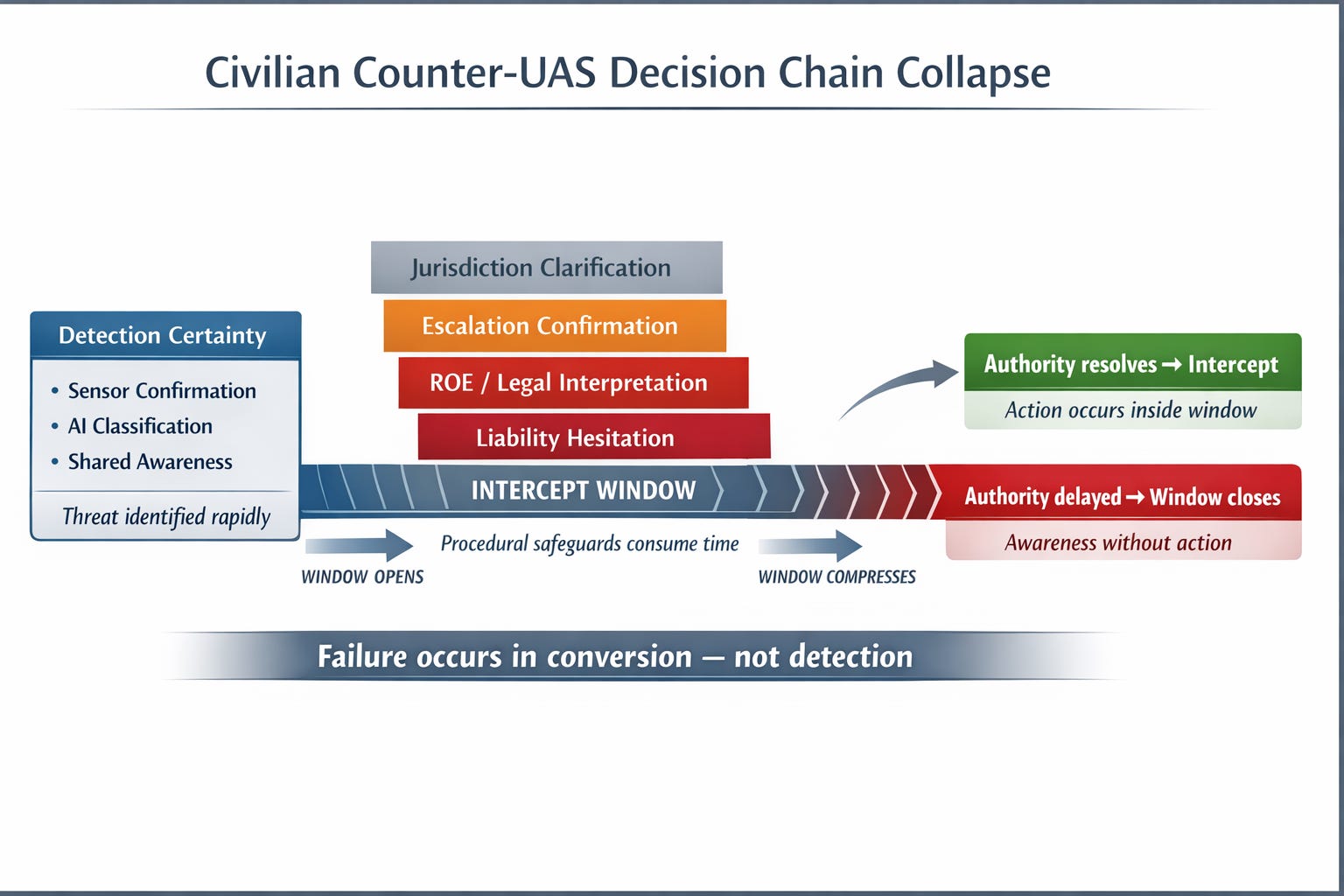
Figure caption:
Modern civilian counter-UAS systems detect threats quickly. Interception fails when authority resolution cannot compress fast enough to match the available decision window. Failure occurs in conversion - not detection.
Transition — Structural Audit
Operational diagnosis alone does not change outcomes. The civilian counter-UAS problem is structural, which means it must be evaluated structurally.
The question is no longer whether detection systems function. The question is whether authority pathways can resolve inside the intercept window.
The following checklist is not procedural guidance. It is a friction audit - a way to expose where decision latency quietly defeats interception before action becomes possible.
Operator Summary — Civilian Counter-UAS
Civilian drone interception rarely fails because a threat is unseen.
It fails because authority cannot convert detection into action fast enough to match the intercept window.
Modern systems compress awareness into seconds. Civilian decision chains still assume time for confirmation, jurisdiction clarification, and liability evaluation.
Each step is correct.
Together, they outrun the clock.
A drone incursion is not primarily a sensing problem - it is a decision compression problem. If authority cannot resolve inside the available window, interception exists only in theory.
Detection speed is irrelevant if authority speed cannot match it.
Counter-UAS Decision Friction Audit
Operator Checklist — Civilian Airspace
Use this as a structural stress test. The goal is not compliance - it is identifying where interception fails when seconds matter.
1) Authority clarity
Who is explicitly authorized to neutralize a drone in controlled civilian airspace?
Is that authority written, rehearsed, and universally understood?
Would all stakeholders agree under pressure?
If authority depends on interpretation, hesitation is built in.
2) Escalation latency
How many confirmation steps occur before action is permitted?
Which steps assume time is available?
What delay exists if seconds matter?
Every escalation layer consumes intercept window.
3) Jurisdiction overlap
Where do federal, local, and private authorities intersect?
Who owns the decision under ambiguity?
Shared responsibility often becomes delayed responsibility.
4) Detection → action translation
Does detection automatically trigger an action pathway?
Or does awareness stall in interpretation?
Seeing the threat is not the same as converting it into action.
5) Liability pressure points
Where does fear of wrongful action override tempo reality?
Are operators protected when acting inside defined conditions?
Unprotected authority defaults to delay.
6) Time assumption test
Does your response model assume clarity arrives before the intercept window closes?
If yes, the architecture is misaligned with drone tempo.
Transition — Post-Audit Reality
What this audit reveals is rarely technical weakness. It exposes where civilian authority architecture assumes deliberation in an environment that no longer permits it.
Detection has already accelerated. The remaining constraint is decision compression.
Until authority pathways resolve inside shrinking windows, counter-UAS capability remains theoretical - visible, understood, and structurally unable to act in time.
Closing — The Window Does Not Wait
A drone incursion is not a hypothetical governance debate.
It is a physics problem intersecting with civilian authority.
The aircraft moves. The drone moves. Time collapses.
The question is never:
Did we see it?
It is:
Could we act before the window closed?
Until civilian decision architecture resolves at the tempo of detection, interception remains aspirational.
The clock is indifferent to jurisdiction.
The intercept window does not wait.
Shareable Pull Quotes
A drone incursion is not a sensing failure. It is a decision failure under time pressure.
Detection compresses time. Authority must compress with it - or the intercept window closes anyway.
Every confirmation step assumes the clock is negotiable. The intercept window is not.
Seeing the threat faster doesn’t matter if permission to act arrives too late.
Civilian counter-UAS failure is jurisdiction moving slower than physics.
If authority cannot resolve inside the window, interception is theoretical.